This post may include affiliate links. We do earn a commission for products purchased using these links (at no additional cost to you). Thank you for supporting Swing Yard, making the content you see on this blog possible. For more information, please see our privacy policy for details.
*Read our review guidelines.
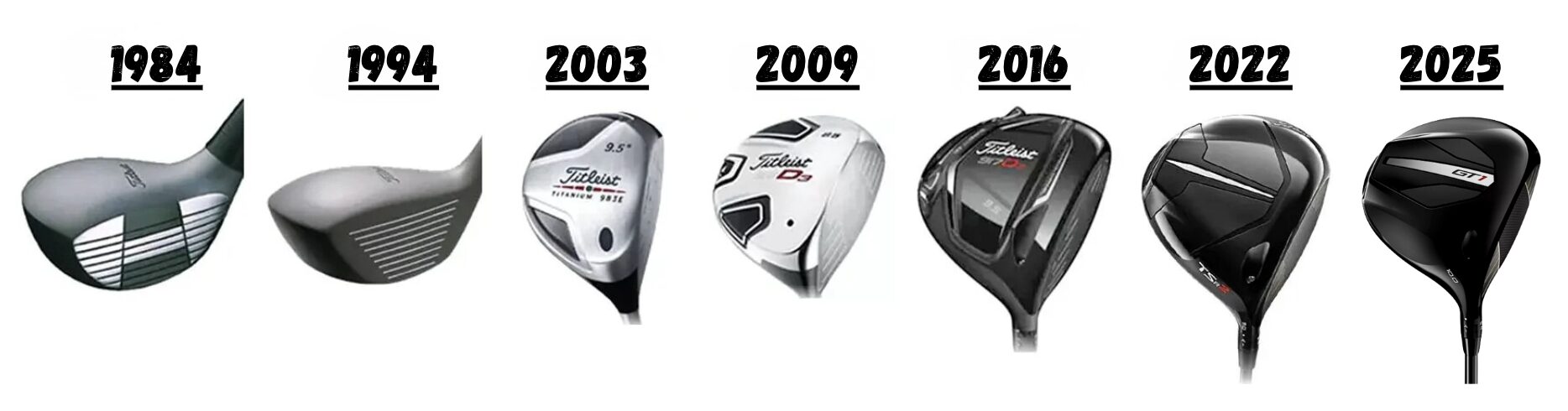
Titleist Drivers by Year Table:
| Year Released | Titleist Driver Models | Key Innovation / What Changed | Price / Where to Buy |
|---|---|---|---|
| 2026 | GTS2 | Launch of the GTS series. Doubles the Proprietary Matrix Polymer from 13 to 26 grams with a full thermoform body, freeing up weight for a new Split Mass Frame. New Speed Sync Face improves ball speed on high face strikes, and the front and back flat weights can be flipped to tune launch and forgiveness. | |
| GTS3 | Same full thermoform body, Split Mass Frame and Speed Sync Face as the GTS2 in a more compact, deeper face shape. Pairs a forward CG track weight with a rear flat weight for lower launch and spin plus adjustable shot shape. | ||
| GTS4 | Lowest spin model in the family, now in a full 460cc head instead of the 430cc GT4 for far more forgiveness on off center strikes. Uses the same forward track and rear weight setup as the GTS3. | ||
| 2025 | GT1 | Completed the GT family. Deepest CG placement in the lineup for a higher launching, mid spin flight, plus an ultra lightweight shaft and grip built for moderate swing speed players. | |
| 2024 | GT2 | Launch of the GT series. First Titleist driver to move off all titanium construction, replacing the crown with a Proprietary Matrix Polymer. Highest MOI option in the family for max forgiveness. | |
| GT3 | Same Seamless Thermoform Crown and Speed Ring/VFT face as the GT2, built around a five position CG track for adjustable launch and spin. | ||
| GT4 | 430cc low spin tour head with dual spin control settings, aimed at faster swing speeds wanting a penetrating, workable flight. | ||
| 2023 | TSR1 | Added a year after TSR2/3/4. Ultra lightweight build with a variable face for high launch, made for slower swing speed players. | |
| 2022 | TSR2 | Launch of the TSR line. Refined aerodynamics and a multi radius face for better all around forgiveness and ball speed retention. | |
| TSR3 | SureFit CG track carried over and tuned for better players wanting adjustable shot shape control. | ||
| TSR4 | Low spin tour profile aimed at the fastest swing speeds wanting maximum workability off the tee. | ||
| 2021 | TSi1 | Lightweight addition to the TSi family for higher launch and easier swing speed, released alongside the TSi4. | |
| TSi4 | Smaller, low spin tour head rounding out the TSi line for faster swing speed players. | ||
| 2020 | TSi2 | Debut of TSi (Titleist Speed Impact). Multi material construction with an ATI 425 titanium face and Active Recoil Channel for forgiveness across the face. | |
| TSi3 | Added SureFit CG track to the TSi shape for better player adjustability. | ||
| 2018 | TS1 | Launch of the TS (Titleist Speed) line. Lightweight build for higher swing speed and easier launch. | |
| TS2 | Radial Speed Face for max forgiveness and ball speed across a wider area of the face. | ||
| TS3 | Active Recoil Channel 2.0 paired with an adjustable CG, built for better player versatility. | ||
| TS4 | Smallest, lowest spin head in the TS family for players wanting maximum workability. | ||
| 2016 | 917 D2 | Introduced SureFit CG, a sliding weight track on the back of the head for the first time, on top of the existing SureFit adjustable hosel. | |
| 917 D3 | Same SureFit CG track in a smaller, lower spin profile for better players. | ||
| C16 | Limited release tour focused driver built for compact shaping and workability. | ||
| 2015 | 915 D4 | Higher MOI, draw bias option added to the 915 line for players who needed extra forgiveness against a slice. | |
| 2014 | 915 D2 | Active Recoil Channel 2.0 added to the existing SureFit hosel for more ball speed on low face strikes. | |
| 915 D3 | Same Active Recoil Channel 2.0 in a smaller, lower spin shape for better players. | ||
| 2012 | 913 D2 | Debut of the SureFit hosel, giving golfers adjustable loft and lie for the first time in a Titleist driver. | |
| 913 D3 | Same adjustable SureFit hosel in a smaller, more compact head for skilled ball strikers. | ||
| 2010 | 910 D2 | First Titleist driver with a fully adjustable hosel, allowing golfers to fine tune loft and face angle. | |
| 910 D3 | Same adjustable hosel technology in a lower spin, more compact shape for better players. | ||
| 2009 | 909 D2 | Refined aerodynamic shaping over the 907 line, with a fixed hosel and a focus on forgiveness. | |
| 909 D3 | Smaller, more compact version of the 909 shaping for better player workability. | ||
| 909 D COMP | Compact head option built for players wanting a more workable, traditional shape. | ||
| 2007 | 907 D1 | Thinner clubface than the 905 generation, aimed at higher ball speeds across more of the face. | |
| 907 D2 | Larger, more forgiving version of the thinner faced 907 design. | ||
| 2005 | Pro Titanium 905T | Tour shape in the 905 line, built for lower spin and a more compact look at address. | |
| Pro Titanium 905 R | Mid sized forgiveness option positioned between the 905T and 905S. | ||
| Pro Titanium 905S | Largest, most forgiving shape in the 905 family for higher handicap players. | ||
| 2003 | Pro Titanium 983 K | Debut of the Pro Titanium line. Oversized, deep face shape built for forgiveness and distance. | |
| Pro Titanium 983 E | Compact, elliptical shape built for better players who wanted more workability than the 983K. | ||
| 2002 | 975 L-FE | Variable face thickness technology applied across the 975 line for more consistent ball speed. | |
| 975 J-VS | Variable spin version of the 975J, aimed at golfers needing a different launch and spin window. | ||
| 2001 | 975 J | Smaller, more workable head than the original 975D, aimed at better ball strikers. | |
| 1998 | Titanium 975 D | Titleist’s breakout titanium driver and the club that turned the brand into a true driver player on tour. | |
| Howitzer | Stainless steel driver released alongside the 975D for players not yet ready to move to titanium. | ||
| 1996 | Knowright Metal Woods | Adjustable weighting concept aimed at letting golfers fine tune feel and shot shape. | |
| 1995 | DCI Starship | Larger stainless steel head shape built for added forgiveness over earlier metal woods. | |
| 1994 | DTR Midsize Metals | Midsize stainless steel construction aimed at everyday players wanting more forgiveness than a blade style metal wood. | |
| 1984 | Original 1984 Metal Woods | Titleist’s very first driver release, marking the brand’s entry into the metal wood category. |
Titleist Drivers in 2026
The newest Titleist drivers are the GTS2, GTS3, and GTS4, which landed in shops on June 11, 2026. Titleist has stuck to a two year cycle for a while now, so a new family showing up right on schedule after the 2024 GT line was no surprise. The bigger story is how much changed. The GT drivers used 13 grams of Proprietary Matrix Polymer in the crown. The GTS doubles that to 26 grams and wraps it around the whole body. All of that saved weight goes into what Titleist calls a Split Mass Frame, with some mass low and forward for speed and the rest way back for stability. There is also a new Speed Sync Face, which is built for the miss most of us actually hit: a little high on the face.
As for which one fits you, the lineup works the same way it did with the GT. The GTS2 is where most golfers should start, with a high launch, mid spin, and the most help on misses. The GTS3 has a more compact head and a forward CG track, so better players can tune launch, spin, and shot shape. Then there is the GTS4, which might be the most interesting of the three. It is still the lowest spinning model, but Titleist bumped it from the 430cc head of the GT4 up to a full 460cc, so low spin no longer comes with a big forgiveness penalty. One thing to note is that there is no GTS1 yet. If you have a moderate swing speed and want the lightweight build, the GT1 from 2025 is still your club.
2025 – Titleist Drivers
Titleist completed the GT family in 2025 with the addition of the GT1 — the driver in the lineup built specifically for moderate swing speed players who need more help getting the ball in the air. It shares the same Seamless Thermoform Crown and Proprietary Matrix Polymer construction as the rest of the GT family, but the GT1 takes that saved weight and uses it to create the deepest CG placement of any driver in the GT lineup. The result is a high-launching, mid-spin trajectory that is noticeably easier to get airborne without requiring anything extra from the golfer. The GT1 also features an ultra-lightweight shaft and grip as standard, keeping the total weight low enough to help generate more clubhead speed for players who need it.
Titleist Drivers in 2024
The GT series arrived in August 2024 and it was one of the biggest upgrades Titleist had taken in driver design in years. The name GT stands for Generational Technology, and for once that kind of branding actually holds up. The most significant change was the departure from a traditional all-titanium construction. Titleist replaced the crown with a Proprietary Matrix Polymer — a material that had never been used in golf before — which saved enough weight to push mass exactly where each model needed it most. The GT2 is the forgiveness and distance option built for the widest range of players, the GT3 is built for better players who want fine-tuned adjustability with a five-position CG track, and the GT4 is a 430cc low-spin option aimed at faster swing speeds who want a penetrating, workable flight.
All three share the same Seamless Thermoform Crown, an updated aerodynamic profile, and a face that combines Speed Ring and VFT technology for better ball speed for both the good strikes and the bad ones. Titleist was already the most played driver on the PGA Tour for five years running when the GT line launched — the GT series only added to that story.
Titleist Drivers in 2023
TSR1: Ultra lightweight driver made for the slower swing speed player. Variable face for high launch and ultimate forgiveness. Lightweight shaft and grip offers balance to the lighter clubhead.
In 2022, Titleist released the their newest line of drivers – the TSR. Although there is no TSR1 this time, the line up does include the TSR2, TSR3, and TSR4.
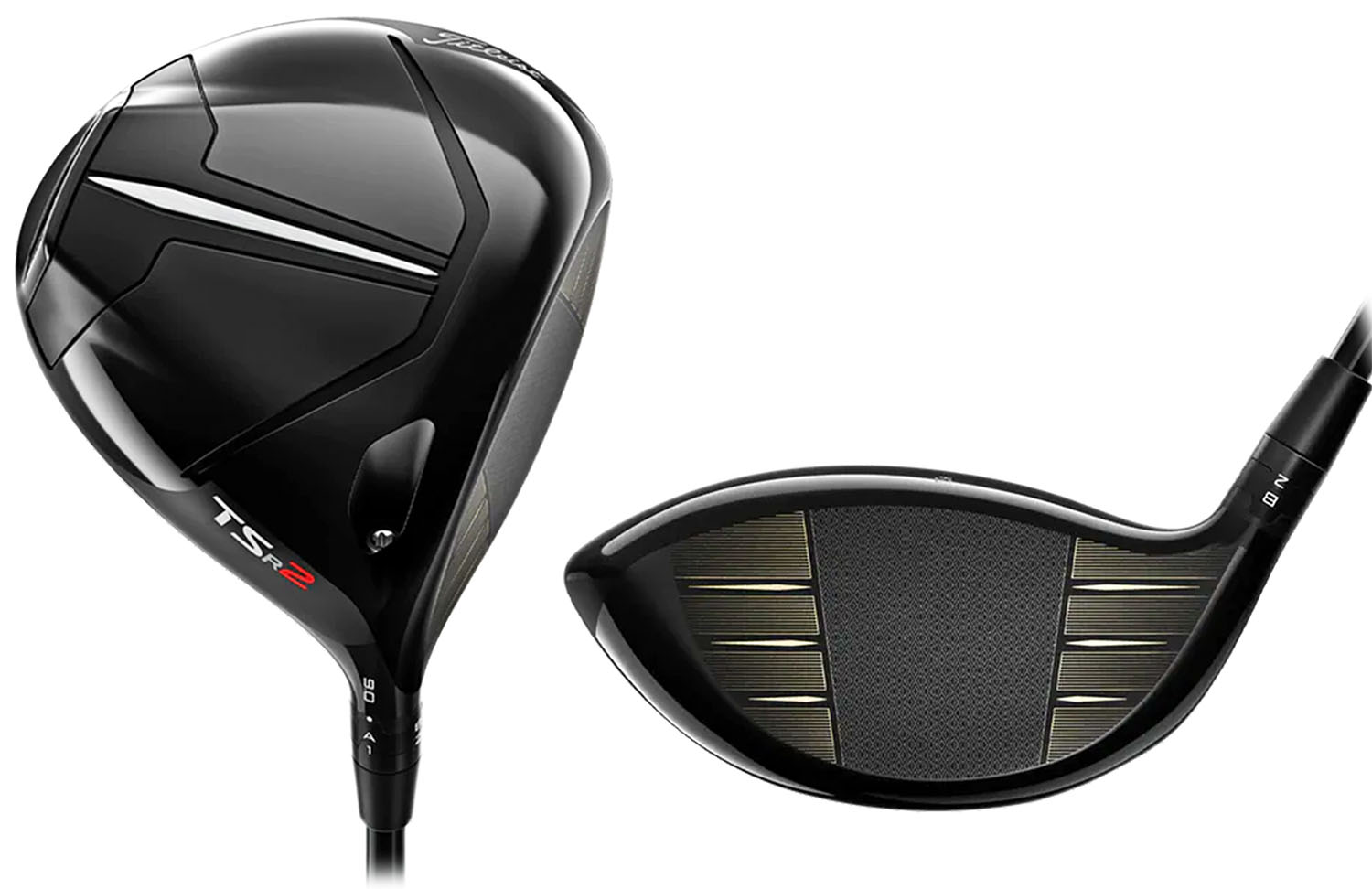
The TSi (1,2,3 and 4) was released in 2020 and 2021. The TSi2 and TSi3 were released in late 2020, while the TSi1 and TSi4 were released in early 2021.
TSi stands for Titleist Speed Impact. But honestly, it’s not the acronym that matters, it’s the performance… right?!
The TSi family is one of the top driver lines out today, and definitely competes with the other big OEM’s, even those who release new drivers every year (which Titleist does not).
Get Smarter About Your Swing
Join thousands of golfers getting exclusive swing tips, club reviews, and gear guides straight to their inbox – before they hit the site.
All 4 drivers in the family have their place, and will fit different golfers accordingly. The TSi2 vs TSi3 is the biggest debate in the driver line.
Check out our reviews of each driver below:
- Titleist TSi1 Review (best for low handicap and fixing a slice)
- Titleist TSi2 Review (best for mid handicap)
- Titleist TSi3 Review (best for low handicap and pros)
- Titleist TSi4 Review (best for sub zero handicap and pros)
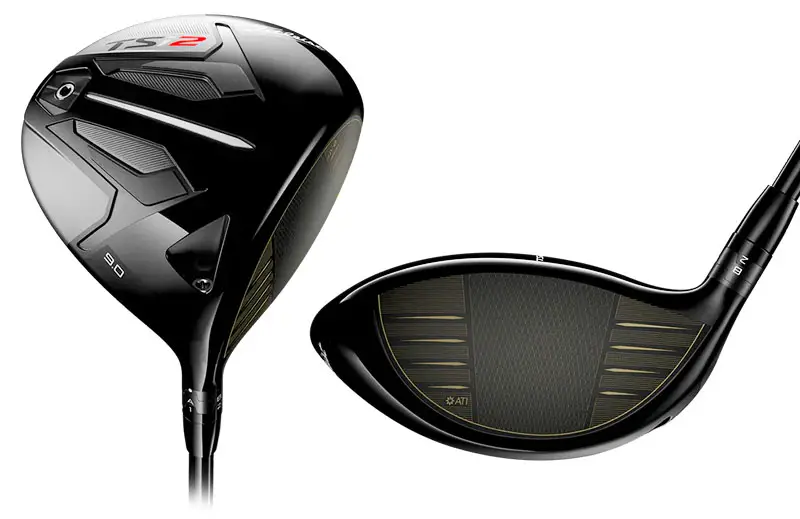
Before that, it was the TS line (no “I” a the end) in 2018 with the TS1, TS2, TS3, and TS4. TS stands for Titleist Speed.
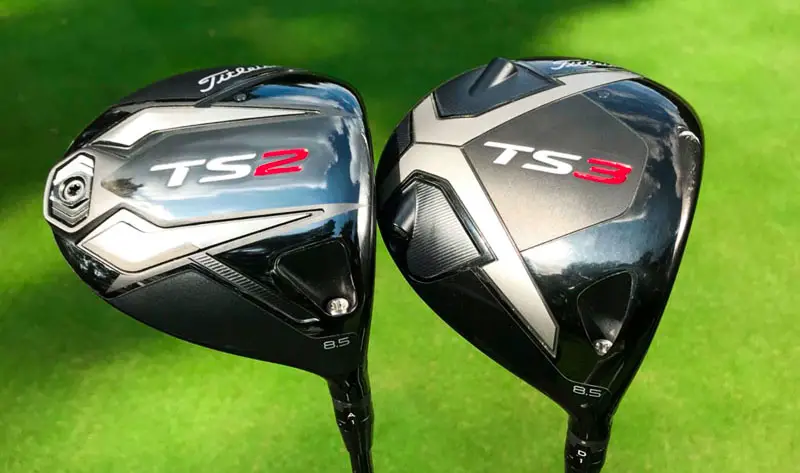
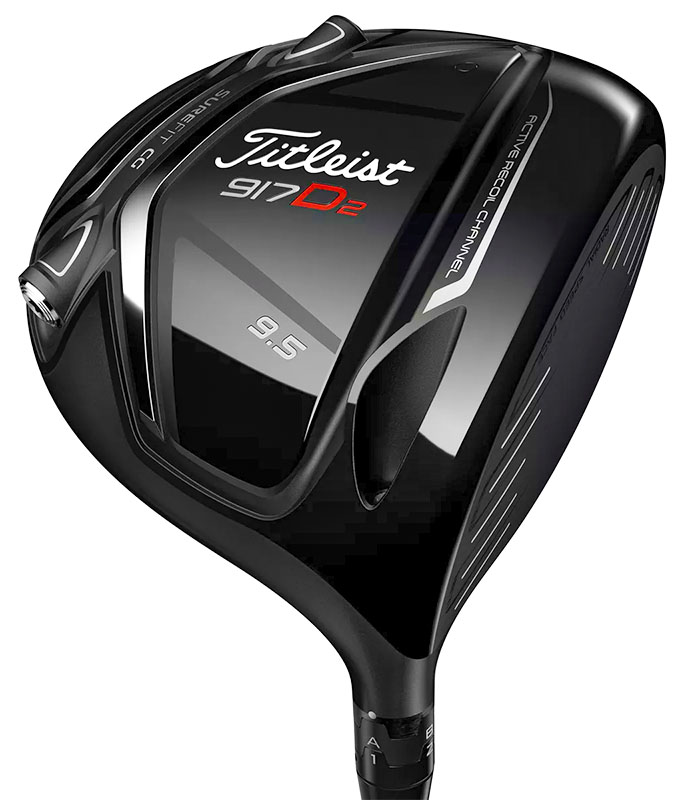
And even before the TS line began, still a somewhat recent driver was the D917 D2 and D3.
Early 2000’s
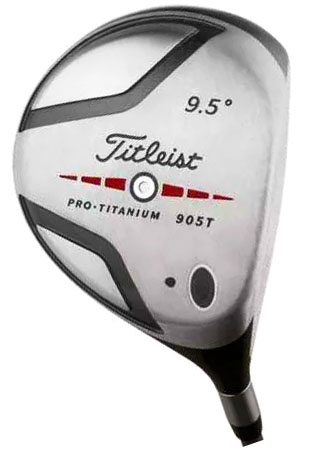
Going back a little further, Titleist started the 2000’s with the 975J in 2001, and the infamous Pro Titanium line in 2003 and 2005.
How It All Started
Titleist, actually under the official name of Acushnet Company, was founded in 1932 by Phillip E. Young (who graduated from MIT by the way). Young has missed a “sure” putt while playing a round with his dentist. He was sure it was due to the uneven weight of the ball, so he asked the dentist to X-ray the ball.
The x ray showed that the rubber core was off centered. So Young decided he was going to develop a machine that could uniformly wind rubber into a “dead center” golf ball.
And thus, the #1 ball in golf was born!
Watch
New videos every week on our youtube channel
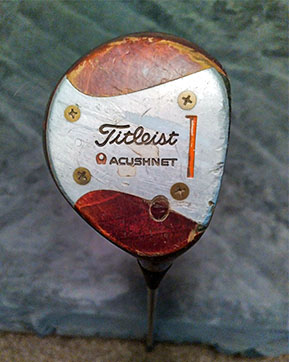
It wouldn’t be until 1984 that Titleist produced their first driver, only known as metal woods back then.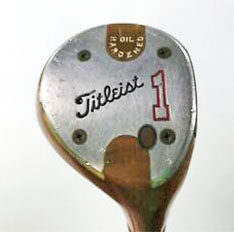
Frequently Asked Questions (FAQ)
The newest Titleist driver as of 2025 is the GT1, which hit retail in February 2025 and completed the GT family alongside the GT2, GT3, and GT4 that launched in August 2024. The GT1 is built for moderate swing speed players who need a higher launch and more help getting the ball airborne, while the GT2, GT3, and GT4 cover forgiveness, adjustability, and low-spin tour performance respectively.
GT stands for Generational Technology. Titleist introduced the name with the 2024 driver lineup to mark what they considered the biggest leap forward in their driver design history, specifically the move away from an all-titanium construction to a multi-material build using a Proprietary Matrix Polymer crown that had never been used in golf before.
Each model targets a different type of player. The GT2 is the highest MOI option built for the widest range of golfers who want forgiveness and consistency off the tee. The GT3 is the adjustability model, featuring a five-position CG track so better players can dial in launch and spin based on their natural strike tendencies. The GT4 is the tour option with a smaller 430cc head with dual spin control settings built for faster swing speeds who want a low, penetrating flight with as little spin as possible.
Swing speed is the deciding factor between these two. The GT1 is ultralight with the deepest CG in the GT lineup, built specifically for moderate swing speed players who need maximum help with launch and carry. The GT2 serves a broader range of players including those with faster swing speeds who want high MOI forgiveness without the ultralight setup. Both are forgiving, both launch high and the GT1 just does it with less effort required from the golfer.
The Titleist TSR2, TSR3, and TSR4 launched in 2022. The TSR1 followed in 2023 as the lightweight, high-launch addition to the family. The entire TSR series was replaced by the GT lineup in 2024. The TSR2 and TSR3 are both still strong used market picks now that a full generation has passed and prices have come down meaningfully.
The GT1 is the best current option for high handicappers and moderate swing speed players. The ultralight build, deep CG placement, and high-launch profile make it the easiest Titleist driver to hit well without having to do anything extra. The GT2 is worth considering if your swing speed is a bit higher but you still want all the forgiveness you can get. For anyone shopping used, the TSR1 is an excellent pick at a fraction of the current retail price.
Titleist has been the most played driver on the PGA Tour for five consecutive years. The GT3 is the most common model in tour bags given its CG adjustability and the compact pear-shaped profile that better players tend to prefer at address. The GT4 shows up regularly too for players who want maximum spin reduction. Titleist does not rely on one headline tour ambassador the way some brands do and their tour presence is built on being the most played brand across the field week in and week out.
Titleist runs on roughly a two-year release cycle, one of the longest in the industry. The TSR series came out in 2022, the GT2, GT3, and GT4 followed in 2024, and the GT1 rounded out the family in early 2025. That slower cadence is intentional and Titleist has been consistent about saying they only release when there is a genuine performance reason to, which is part of why their drivers tend to hold their value better than most brands on the used market.
The most meaningful difference is the crown construction. The GT series replaced the traditional titanium crown used in the TSR — and every Titleist driver before it — with a Seamless Thermoform Crown made from a Proprietary Matrix Polymer. That material change freed up discretionary weight that engineers used to improve CG placement in each model individually, producing better ball speed, more consistent spin rates across the face, and improved feel at impact compared to the TSR generation.
Yes, and Titleist drivers age particularly well compared to most brands. The TSR2 and TSR3 are the obvious used market picks right now — both are capable drivers that tour players gamed at the highest level, and prices have dropped significantly since the GT series launched. One thing worth knowing about Titleist specifically is that their two-year release cycle means used prices do not crash as fast as they do with brands releasing annually. You tend to get more for your money buying used Titleist than you do with most other brands.
Other Brands Drivers By Year

Leave a Comment