
This post may include affiliate links. We do earn a commission for products purchased using these links (at no additional cost to you). Thank you for supporting Swing Yard, making the content you see on this blog possible. For more information, please see our privacy policy for details.
*Read our review guidelines.
Scratch golfers are often one of the most common misconceptions in golf. Why do you ask? Well, people just assume that a scratch golfer arrives at any golf course and shoots par every single round. That is, if par on that course is 72, said golfer will shoot 72. That is very far from the truth. So, what is a scratch golfer then?
A scratch golfer is often viewed as the gold standard of amateur golfers. A scratch golfer is someone who carries a handicap index of zero (or near zero). This ultimately means that the golfer is consistently shooting around par at their home course. Ok, that clarifies it a little bit, but what is a golf handicap then?
What Is A Golf Handicap?
A golf handicap is a metric that golfers carry by entering their scores, most commonly, into the USGA handicapping system. This system evaluates your scores against the slope and course rating of the courses you play and selects the best 8 of your last 20 rounds of golf. The handicap then becomes a metric you can use to compare your rounds against the respective course’s par that you’re playing.
For my math nerds, to physically calculate a golf handicap, you find the Score Differential for each round (using Adjusted Gross Score, Course Rating, and Slope Rating), then average your lowest differentials (typically the best 8 of your last 20 rounds) and multiply by 0.96 to get your Handicap Index, This then can convert to a specific Course Handicap for any course you play. The actual equation looks like this: (Adjusted Gross Score – Course Rating – PCC adjustment) x (113 / Slope Rating)
Golf Handicap Example
Let’s try and simplify that a bit by providing a basic example. If you have a handicap of 10 and the slope rating of this example course is 113 (which, 113 is logged as the average slope rating metric) with a course rating of 72 (meaning the course plays at exactly 72 strokes for a scratch golfer, not harder than 72 or easier than 72). Then this golfer would theoretically get 10 strokes against the course. So, for this 10 handicap golfer to shoot “par” at this course means they would need to shoot an 82.
You see, the handicap metric is used so that golfers of all skill ranges can compete against the course and one another competitively and fairly. It allows someone like Scottie Scheffler, who probably carries a +8 or +9 handicap (meaning, he has to give the course 8 or 9 strokes!) to compete against his buddies competitively, even though they aren’t as good as World #1. Scottie needs to shoot 8 or 9 under par on this example course to shoot his version of “par”. Which is a crazy metric to think about.
Golf Scorecards & Handicaps
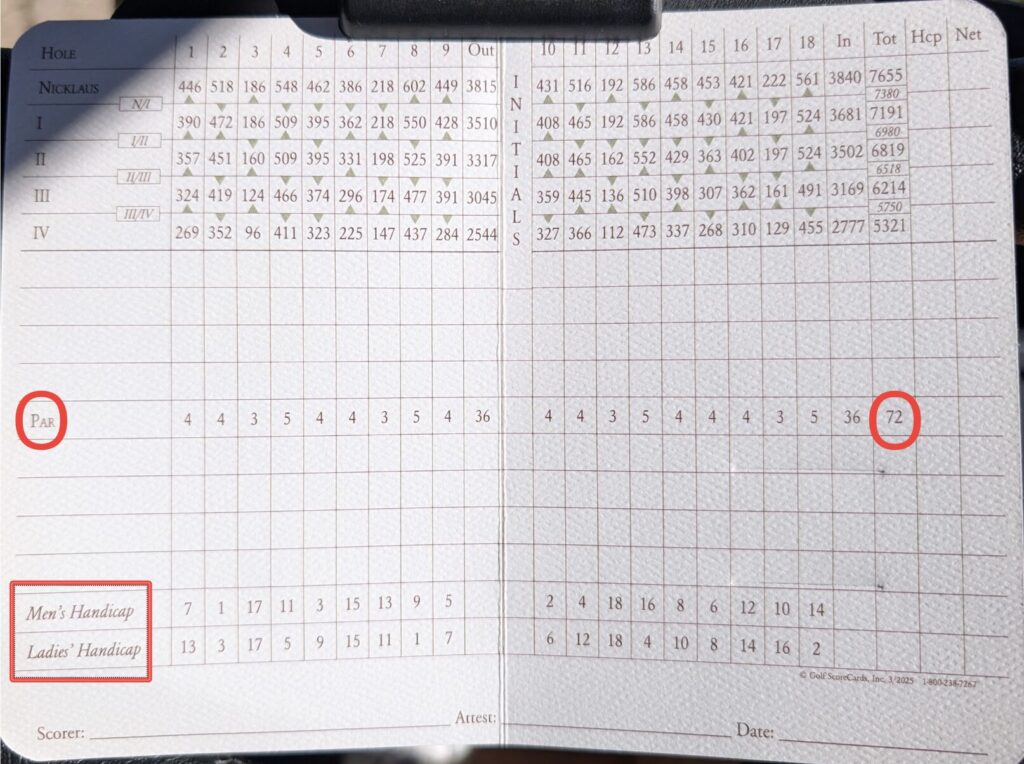
On any golf scorecard, you can find the Par and Handicap. See below as an example, and, using my example from above, this 10 handicap golfer would “get strokes” on the respective Handicap holes, 1-10. So, if this gentlemen recorded a score of 5, on hole #2, which is a par 4, he would have effectively recorded a par, based on his handicap.
Finally, another way to understand handicaps, using this same example, is that hole #2 is Men’s Handicap #1 – which means that this is recorded as the toughest hole on the course. As the handicap number on the scorecard gets higher, theoretically those holes play easier.
What Is A Slope Rating In Golf?
A golf slope rating measures a course’s difficulty for bogey golfers (around 18-over-par) compared to scratch players, indicating how much more challenging it is for less skilled players. This would often be due to factors like the length of the golf course and hazards. The average slope rating is 113 but it ranges anywhere from 55-155. Higher numbers signify a harder course for average players, while a lower number means it’s easier. These ratings also help golfers choose appropriate tees to make golf games on the course as fun as possible.
What Is A Course Rating In Golf?
We haven’t quite gotten to the bottom of, what is a scratch golfer? By explaining these other terms and ratings, it starts to take shape though. So, how about the term, course rating, what does that mean?
A course rating is basically the determination of what a scratch golfer will shoot on that course from each respective tee. Of course, each course has different tee boxes so each tee box has it’s own course rating and slope. The farther back you go, the harder the golf gets and the higher both of those values go. In my original example, with standard course rating and slope settings (72 CR / 113 SLOPE), a scratch golfer will shoot 72. Assuming again, that 72 is par for the course. I hope this is a little more straightforward to understand as anything above a 72 course rating means the course plays slightly harder than average and anything below 72 means it’s easier.
Get Smarter About Your Swing
Join thousands of golfers getting exclusive swing tips, club reviews, and gear guides straight to their inbox – before they hit the site.
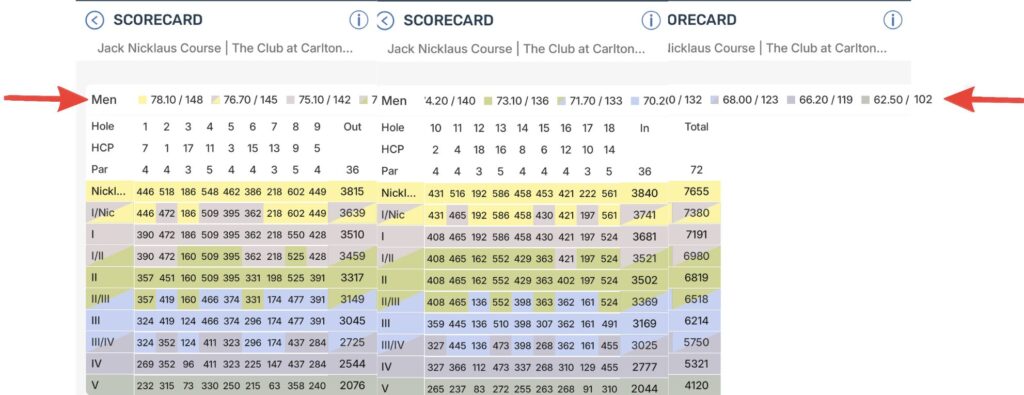
The Slope and Course Rating are commonly listed on most golf scorecards. If they aren’t, you can check the Course Rating and Slope Database for the course you’re playing. You can see in the screenshot below that the higher values are assigned to tees played from further back. I took these screenshots from my favorite Grint app to mimic my image from above when I played this course. The Nicklaus tees play at a monstrous distance of 7,655 yards which boasts a 78.10 course rating and a slope of 148! This indicates that if a scratch golfer came and played well here, they would likely shoot a 78! If this same scratch golfer played from the green tees (II), he would likely shoot closer to a 73. I hope my illustrations are making sense…
Traits Of A Scratch Golfer
Now that we have narrowed down the physical definitions of what a scratch golfer is. We can further diagnose how these golfers differentiate themselves from your average joes. There are several obvious things that come to mind, so let’s just list them out:
- Ball Striking is far superior to that of a golfer with a higher handicap.
- Course Management is not only understood but is applied to all golf shots.
- Short Game – Has a quality short game. This doesn’t mean said golfer gets up and down every time, but it likely means they are giving themselves that chance most times.
- Putting – Scratch golfers have the ability to make putts. Consistent success with short putts, occasional midrange makes and infrequent 3 putt mishaps.
- Mental Strength – A common characteristic in higher handicap players is that they give up frequently and quickly. I cannot stress how important it is to remain mentally strong if you want to get to the next level in golf.
- Fairways and Greens – On average, scratch golfers will hit the majority of both of these. The more of these you hit, the better your scores will be.
- Routines/Practicing Strategies/Fitted Clubs/Iron and wedge gapping/training aids – golf is hard, it takes practice and there’s probably a lot more…
Tools To Help You Become A Scratch
Becoming a scratch golfer, or 0 handicap, is primarily geared towards becoming as consistent as you can. Consistent with driving, irons, wedges, short game and putting. If you can consistently learn how to avoid the big numbers on the golf course and understand when you can and can’t play risk/reward shots, you will likely start to shave strokes.
We’ve built a lot of tools already to help you get better and it truly depends on your personal golf journey. Let me share some of the details and allow you to choose what would work for you.
- Golf 101 for Beginners
- Build your own golf simulator so you can practice at home!
- How to break 100
- How to break 90
- How to break 80
- How to break 70
- How to hit a driver
- How to fix a slice
- Golf putting tips
- Track on course stats with phone apps such as The Grint or 18 Birdies
Lastly, feel free to hit us in the comment section below if there’s something you’d like help with!
Common Myths Of Scratch Golfers
Scratch golfers DO NOT shoot par every time out. It seems to be a common trend that people think this is a true statement. In fact, the majority of scratch golfers will rarely shoot par. Scratch golfers will have a variety of rounds around par. This means they might shoot three under one round and might shoot 7 over the next. But, you’ve now learned that it’s more of an average of these scores against the difficulty of the courses the golfer is playing that determines where the player’s handicap index is.
One more point on this topic. Scratch golfers are NOT pros. In fact, they are very far from it. While only the top 2% of golfers will ever get to a 0.0 handicap index, true professional golfers are way better than this. Using my Scottie Scheffler example from above, he will still theoretically beat a scratch golfer by ~8 strokes in an average round, 8 strokes! Insane, but it goes to show just how good the pros are.
Final Thoughts For Defining What Is A Scratch Golfer?
Becoming a scratch golfer is more than just hitting great shots every time you stand up to the ball. Trust me, as a scratch golfer myself, I am frequently underwhelmed with the performance of my swing. However, it takes more than one bad swing to ruin a golf hole and golf round. Practice, mental focus and fixing the things that you can control will go a long way.
Work hard to set yourself up for success and find ways to gain an edge, like club fittings, practice drills or new fun instructive tools. By doing the little things, it’ll make the bigger things seem like less.
Watch
New videos every week on our youtube channel
This post includes affiliate links. I do earn a commission for products purchased using these links (at no additional cost to you). Thank you for supporting Swing Yard, making the content you see on this blog possible. (more info). Please also check out 2nd Swing, our preferred retailer for all things golf!
Frequently Asked Questions (FAQ)
The definition of a scratch golfer means the player will have a handicap index of 0.0. This means that the golfer will typically be shooting right around par as an average for their better rounds. Again, a golf handicap is often based on your best last 8 of 20 rounds. As in, the average of those 8 good rounds should be about par when scored against the course rating that they play.
It’s extremely rare. In fact, less than 2% of handicap-holding golfers worldwide achieve scratch status, per the USGA data.
You need to start by taking golf seriously. You will need to put time into practicing and dialing in on the small things. You’ll need to understand course management and determining where you can and can’t miss shots. Work on perfecting the stuff you can control and becoming as consistent as possible. As I mentioned above, club fittings, practice drills and advanced instructive tools will help to shape your game. Final note, it takes mental strength and you will need to learn that you cannot give up with one or two bad holes.
No, quite a bit different actually. Scratch golfers are commonly shooting between 70-75 while tour pros will frequently be shooting below 70, with tour pressure, and on much more challenging courses. While I will classify all of these golfers as “very good”, the tour pros are still a large step ahead of the scratch golfers.



Leave a Comment