This post may include affiliate links. We do earn a commission for products purchased using these links (at no additional cost to you). Thank you for supporting Swing Yard, making the content you see on this blog possible. For more information, please see our privacy policy for details.
*Read our review guidelines.
If you have ever played in a casual golf tournament or joined a club competition and heard someone mention Stableford scoring. So, what is stableford scoring? How does Stableford scoring work? I get these questions a lot, so I figured it was time to break it down in plain language — no fluff, just everything you need to know to understand the system and actually use it on the course. In short, this is a fun game that can equal the playing field for all levels of golfers and it can eliminate the dreaded blow-up hole from ruining your entire competition against your buddies.
What Is Stableford Scoring?
Stableford scoring is a points-based golf format where you earn points on each hole based on how your score compares against your handicap and the par of the hole. Instead of counting every single stroke across 18 holes, like traditional stroke play, you are accumulating points. The higher your points total at the end of the round, the better.
The format was invented by Dr. Frank Barney Gorton Stableford in 1931 and first used in competition at the Wallasey Golf Club in England. The idea behind it was brilliant and simple — reduce the damage a bad hole can do to your overall round. In stroke play, one disastrous hole can ruin an otherwise great round. In Stableford, you pick up your ball, take your zero points for the hole, and move on. Mentally, it changes everything and can mimic the match play format and mindset.
It is one of the most popular formats in recreational and golf worldwide, and once you understand how the points work, you will probably wish more of your rounds used this format.
How Does Stableford Scoring Work?
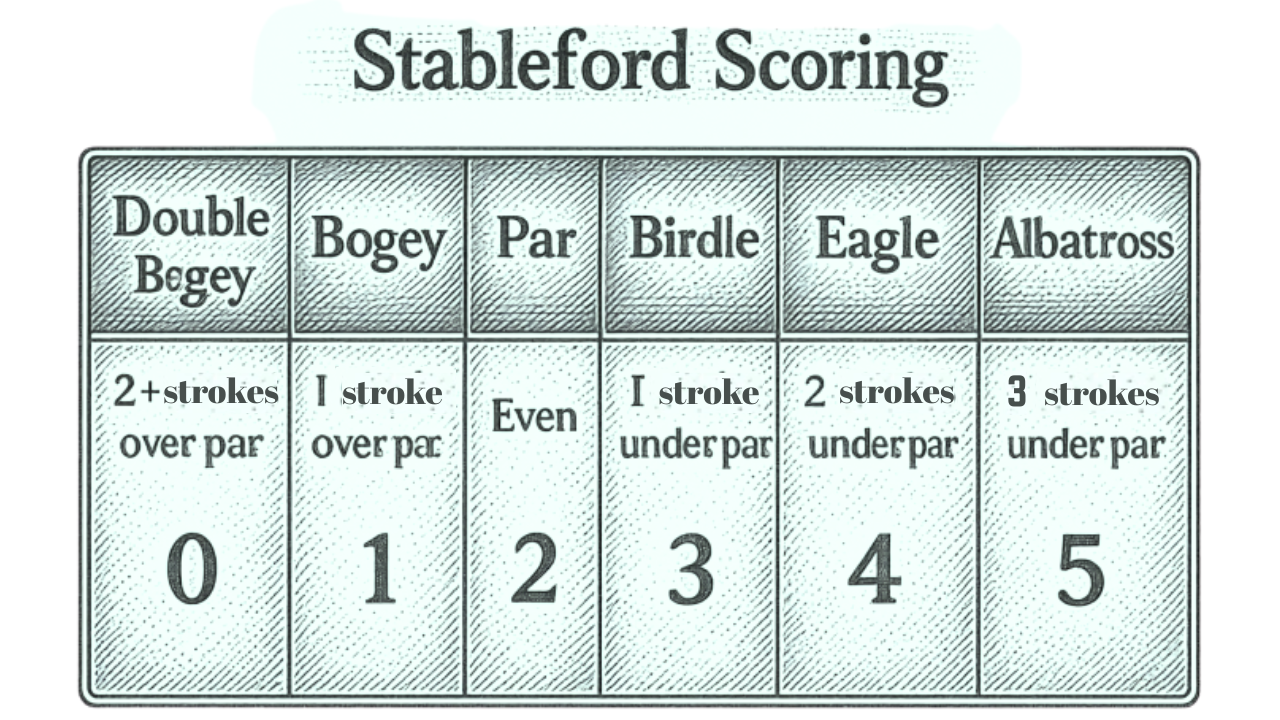
Each hole is worth a certain number of points depending on how you score relative to par. Here is the standard Stableford points breakdown when compared against a scratch handicap golfer:
Stableford Scorecard Table
| Score on Hole | Relation to Par | Points Earned |
|---|---|---|
| Albatross (Double Eagle) | 3 Under Par | 5 Points |
| Eagle | 2 Under Par | 4 Points |
| Birdie | 1 Under Par | 3 Points |
| Par | Even | 2 Points |
| Bogey | 1 Over Par | 1 Point |
| Double Bogey or Worse | 2 Over Par or More | 0 Points |
A perfect round of Stableford — where you par every hole — would give you 36 points. A round where you birdie every hole would give you 54 points. In reality, most recreational golfers consider anything above 36 points a really solid round, and scores in the low-to-mid 30s are completely respectable.
Stableford Scoring With a Handicap
One of the best things about Stableford is how cleanly it works with handicaps. When you play Stableford with your handicap, extra strokes are applied hole-by-hole based on the stroke index of each hole on the scorecard. This means a higher handicap golfer gets to add a stroke, or sometimes two, on specific holes before calculating their points.
Get Smarter About Your Swing
Join thousands of golfers getting exclusive swing tips, club reviews, and gear guides straight to their inbox – before they hit the site.
For example, if you are a 18 handicap player, that traditionally means you get one extra stroke on any given hole. So if you make a 6 (gross score bogey) on a par 5, your net score is actually 5, which equals par, which equals 2 points. Without the handicap stroke that same score would only be worth 1 point.
This is what makes Stableford so enjoyable for golfers of all skill levels. Whether you are working on breaking 90, grinding toward breaking 80, chasing breaking 70, or even pursuing a scratch handicap, the Stableford format keeps every player competitive and engaged throughout the entire round.
A Real-World Stableford Scorecard Example
Here is what a sample front nine Stableford scorecard might look like for a 14 handicap golfer (who would theoretically get 7 strokes on the front 9). I have marked which holes they receive a handicap stroke based on the stroke index:
| Hole | Par | Stroke Index | Handicap Stroke | Gross Score | Net Score | Points |
|---|---|---|---|---|---|---|
| 1 | 4 | 3 | Yes | 5 | 4 | 2 |
| 2 | 3 | 15 | No | 4 | 4 | 1 |
| 3 | 5 | 7 | Yes | 6 | 5 | 2 |
| 4 | 4 | 1 | Yes | 7 | 6 | 0 |
| 5 | 4 | 9 | Yes | 5 | 4 | 2 |
| 6 | 3 | 17 | No | 3 | 3 | 2 |
| 7 | 5 | 5 | Yes | 5 | 4 | 3 |
| 8 | 4 | 11 | Yes | 5 | 4 | 2 |
| 9 | 4 | 13 | Yes | 4 | 3 | 3 |
| Total | 36 | – | – | 44 | 37 | 17 pts |
Notice hole 4 — a rough hole where the player made a triple bogey (7 on a par 4). Even with the handicap stroke that was still a net double bogey worth zero points. In stroke play, that hole could have been mentally devastating. In Stableford, you move on, and the round is still completely salvageable. That is the beauty of this format.
Modified Stableford Scoring
There is also a Modified Stableford format used in some professional events — most famously the PGA Tour’s Barracuda Championship. In this version, the points scale is adjusted to more aggressively reward birdies and eagles while penalizing bogeys. A common modified scale looks like this:
- Double Eagle: +8 points
- Eagle: +5 points
- Birdie: +2 points
- Par: 0 points
- Bogey: -1 point
- Double bogey or worse: -3 points
This version makes the format far more aggressive and is designed to push pros into taking risks. For recreational golfers, the standard Stableford system is the one that’s a bit more common.

Frequently Asked Questions About Stableford Scoring
For most recreational golfers, anything at or above 36 points qualifies as a solid round — that is the equivalent of playing to your exact handicap. Scoring between 30 and 35 is still a respectable day out. Anything above 40 points is a genuinely great round of golf regardless of your handicap level.
It depends on your skill level and what you are trying to get out of the round. For recreational and mid-to-high handicap golfers, Stableford is often a better experience because one bad hole does not derail the entire round. For competitive and low handicap golfers who are tracking every stroke, traditional stroke play is the more meaningful format. Personally, I think every golfer should play at least a few Stableford rounds per season — it takes the pressure off in a way that is genuinely refreshing.
You simply record zero for that hole, pick up your ball if you have not already done so, and move to the next hole. There are no negative points in standard Stableford — your score can never go down, only stay the same or go up. This stands as one of the key differences from the modified format that some professional events use.
Absolutely, and honestly it might be the most beginner-friendly format in golf. Because a bad hole only costs you zero points rather than ballooning your stroke total, new golfers can enjoy a full round without feeling like the round is over after a difficult stretch of holes. It also speeds up pace of play because you can pick your ball up once you cannot score any points on a hole.
Yes. In most club and recreational Stableford competitions you play off your full handicap, with strokes allocated hole-by-hole based on the stroke index on the scorecard. Always confirm the specific rules of the competition you are entering, as some events may use a percentage of your handicap.
Not in the traditional sense, but a Modified Stableford format is used at the Barracuda Championship on the PGA Tour. The points values are different from the standard recreational format, with a stronger emphasis on rewarding aggressive play and penalizing bogeys more heavily.
Why I Think More Golfers Should Play Stableford
After years of playing and watching golfers of every skill level, I genuinely believe Stableford is one of the most underutilized formats in recreational golf. Not only does it keep every player mentally in the round, but it also speeds up pace of play, stays fair across all handicap levels, and eliminates the kind of spiral thinking that kills rounds in stroke play. If you have ever stood on the 14th tee knowing your scorecard is already a wreck, you know exactly what I mean.
Watch
New videos every week on our youtube channel
With that in mind, give it a try on your next casual round or against your buddies. Simply assign yourself points on each hole against par, add them up at the end, and see how it changes the way you think about the game. Once you do, you will likely enjoy 18 holes a whole lot more when one bad hole is just one bad hole — nothing more.




Leave a Comment